
01
Get the evening back
Clinicians spend one to two hours on documentation for every hour of patient care. The pen removes the laptop from the room and the note from the night.
Ann Intern Med, 2016 →Healthcare preview · Not launched
One pen captures every conversation your clinic has, remembers them across visits, and does the work that follows: the note, the coding, the chart. No laptop between you and the patient.
01
Clinicians spend one to two hours on documentation for every hour of patient care. The pen removes the laptop from the room and the note from the night.
Ann Intern Med, 2016 →02
Every clinical fact carries the transcript line it came from. Invented citations are dropped by the server before you ever see them — accuracy you can audit, not a percentage you have to take on faith.
See it work below →03
Coded to the 2021 AMA rule with the evidence attached, and assembled into charge lines your biller can post. The admin tail of the visit, not just the note.
See the worksheet →The app
Four screens is the whole product: what the day holds, what the visit produced, what the record already knows, and what it is worth. Every patient below is synthetic.
Thursday 8 August · 11 appointments
Needs patient
Follow-up · 14 min · 9 of 10 lines traced
SUBJECTIVE
Headache frequency down to roughly two per week, from near-daily. Photophobia persists; nausea resolved.
OBJECTIVE
Blood pressure 118/74.
PLAN
Continue propranolol; follow up in three months. Advised to keep a headache diary.
Answers only from this patient's own visits
Two things, both still in place:
• Propranolol started 14 Feb, raised to 40 mg on 2 May.3 May visit · 04:18
• Sleep hygiene discussed 14 Feb; not revisited since.14 Feb visit · 11:02
No trial of a triptan appears in any visit on file.
One. The neurology referral was sent 3 May and has no reply recorded.3 May visit · 08:44
Established patient · office visit
Two of three at moderate
99214Diagnoses
Memory
Not the last five notes to read. The three things that have not resolved, what each one came from, and what the last visit said would happen next.
Encounters on file
What memory returns, before you open the door
Unresolved
The last plan said
Still waiting
Deterministic — no model call. Every line is a claim about a real patient made before you have seen them, so it is assembled by grouping and ordering the prior visits, not generated. The panel cannot invent a condition and cannot drop one.
Coding & billing
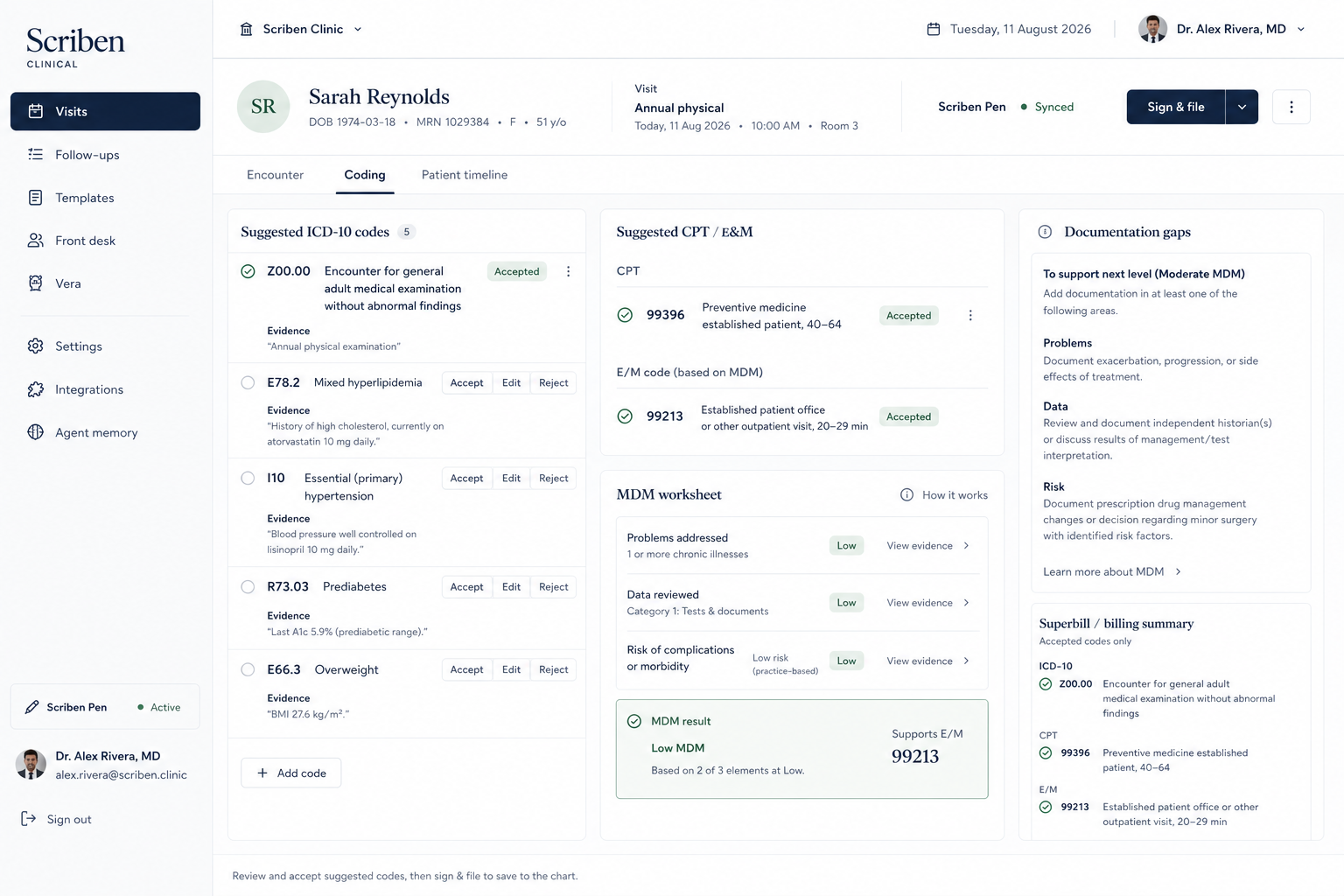
The model reports three observations with transcript evidence. The published 2021 AMA two-of-three rule turns them into a level. Change what the visit supports and the code moves — in front of you, for a reason you can read out to an auditor.
Problems addressed
▸ 00:11 “two a week now, down from most days”
Data reviewed
▸ 00:55 blood pressure reviewed in visit
Risk of management
▸ 00:41 prescription drug management
Level, by the two-of-three rule
99214
Moderate problems and moderate risk — two of three at moderate.
To reach the next level
Would need high risk or extensive data. Not evidenced in this visit — so no wording is offered.
The lowest defensible code is the default direction. An unreadable element ranks lowest, and no read of the note can lift a level.
| Charge | Description | Mod | Dx pointer | Units |
|---|---|---|---|---|
| 99214 | Office visit, established patient | — | A | 1 |
| Dx | Diagnosis | |||
|---|---|---|---|---|
| A | G43.109 — Migraine, not intractable, without status migrainosus | |||
| B | Z79.899 — Long-term drug therapy monitoring | |||
Charges link to the diagnoses supporting them, the way box 24E of a CMS-1500 does — because “which diagnosis justifies this charge” is the question a denial is usually about. This is not a submittable claim and does not pretend to be: payer, subscriber, prior authorisation and place of service live in your practice management system. We carry the part that comes from the encounter; your EHR supplies the rest.
A competitor’s coding assistant, on selecting a code, “automatically updates your note to reflect the specificity required”. That is a tool editing a clinical record so it justifies a billing decision — and the clinician signs the result.
If the missing detail was spoken, the evidence is cited and a one-sentence addendum is offered for you to accept. If it was not, the gap is reported and no wording is offered at all — not a hedge, not a template with a blank in it.
If the evidence is absent, the drafted addendum is discarded no matter what came back from the model. A model told not to draft unsupported wording will mostly comply, and “mostly” is not a control.
“The model proposed 99214 and the clinician took 99213” survives as a stored fact — which is exactly the fact an audit asks about.
The front desk
The day does not end when the patient leaves. Someone still has to get the note into the chart, the referral out, the follow-up on the book and the charge onto a claim. That is the work the pen is actually aimed at.
Why you can trust the draft
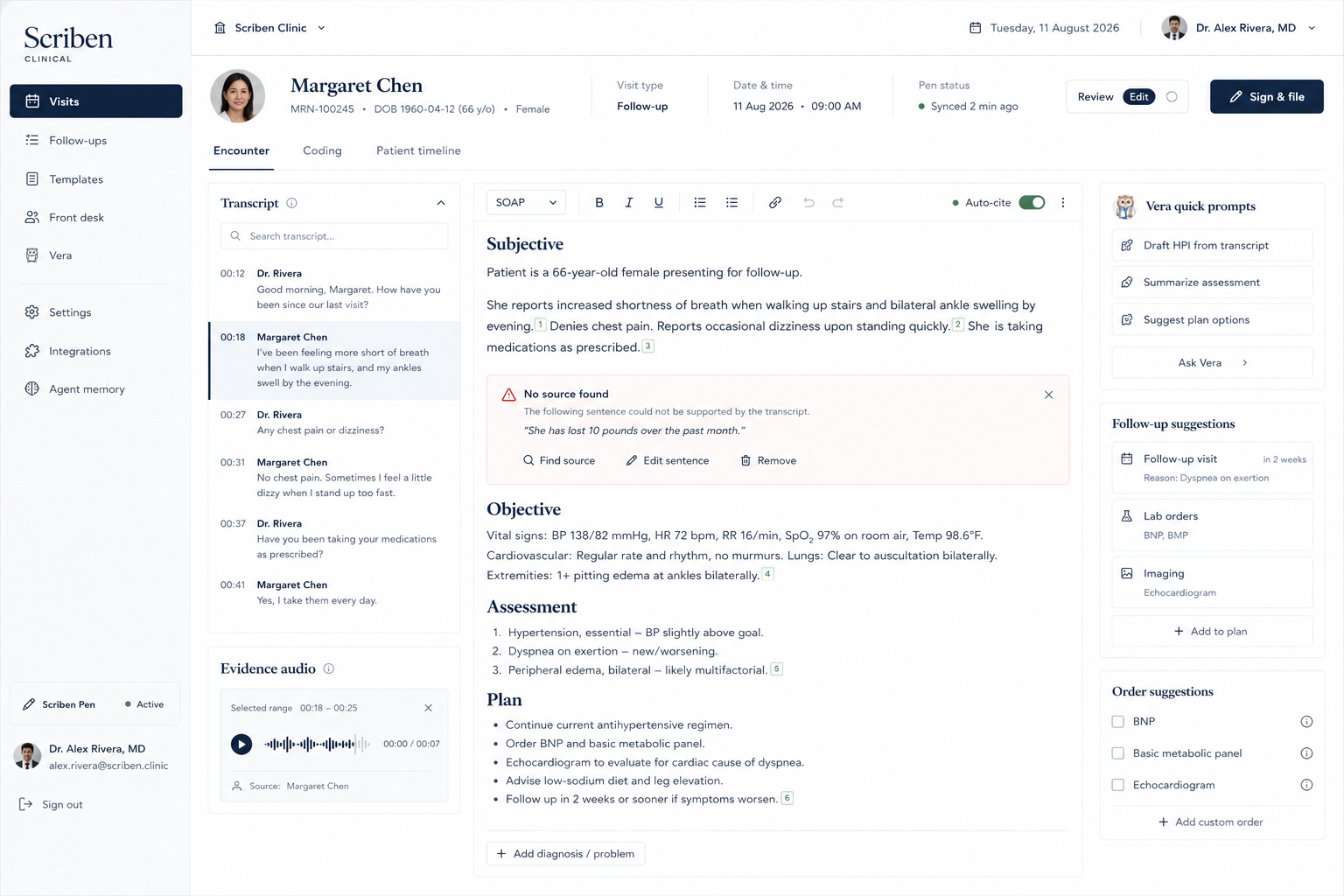
Every ambient scribe writes a plausible note. The question a doctor actually has is narrower: where did this line come from? Click any sentence — the transcript moves to the moment it was spoken.
Or click a transcript line to follow it the other way.
Each line in the note links to the transcript turns it was built from, and to the position in the recording where they were spoken.
If a sentence traces to nothing, it gets a dotted underline and says so. A note where nine sentences in ten trace is a more honest artifact than one implying all of them do.
No vital sign, dosage or lab value that wasn't spoken. No diagnosis you didn't make. Anything heard but uncertain stays uncertain.
A measurement the model supplied reads exactly like one you took. So it never supplies one.
A symptom is not an assessment — and the chart is where that distinction is legally load-bearing.
Coding is a billing decision. It lives in its own worksheet, and only after you accept it.
Resolving ambiguity silently is how a hedge becomes a fact in a permanent record.
Technology
Capture, memory and agent are specialised for clinical work — vocabulary, schema, ranking and feedback all differ from the general product.
Capture engine
Clinical memory engine
Agent engine
On-pen motion sensing. It writes real ink on real paper.
Capture
Doctors already hold one. Nothing to open, nothing to angle at the patient, nothing that signals a device is listening. It writes on paper the way it always has — and the strokes come back as structured data.
The workflow
Six steps from the schedule to a signed note and the follow-ups it generated. You approve everything that leaves.
Pulled from your EHR into the patient list, so the day is already there when you open the app.
Binding happens before a word is spoken. Nothing is ever auto-assigned — not by time, not by a name in the transcript.Never inferred
Hands free, no screen, works offline. The pen is already the most ordinary object on the desk.
What was decided last visit, what changed since, and what you're still waiting on.Across encounters
SOAP note, plus the referrals, labs and follow-ups the visit actually generated — each traced to a line in the transcript.
Note filed to the chart, tasks staged, encounter reference echoed back. Nothing leaves unapproved.You sign, we never do
Integrations
A note that stops in our app is a second place to look, not one less thing to do.
The chart
Schedule in, signed note out, encounter reference echoed back. Every EHR sits behind one vendor-neutral adapter, so adding one is an adapter — not a rewrite.
 Cobalt



Cobalt is the ambulatory rail and is live. Epic follows through a SMART-on-FHIR adapter, with App Orchard onboarding planned on its standard 12–18 month timeline.
The day around it
The same follow-ups the visit generated — the referral letter, the recall, the message to a colleague — go out through the tools your practice already runs on.
Nothing is sent without you approving it, and nothing carrying PHI leaves the clinical surface.
Trust & privacy
Scriben’s clinical privacy and security program is built around protected health information. Clinical access begins after a customer BAA and the approved processing path are confirmed.
Safeguards tracked in Vanta
Controls monitored in Vanta
Current program status · Supporting evidence in Vanta
Your organization signs a BAA, then Scriben confirms the processing path before clinical access is enabled.
We do not use customer content to train Scriben models.
Your data is encrypted while it moves and while it is stored.
SOC 2 Type I readiness controls are monitored in Vanta. A Type I report has not yet been issued. View the Vanta trust center →
A real ballpoint pen that writes on paper, records the room, and gives you back the evening.